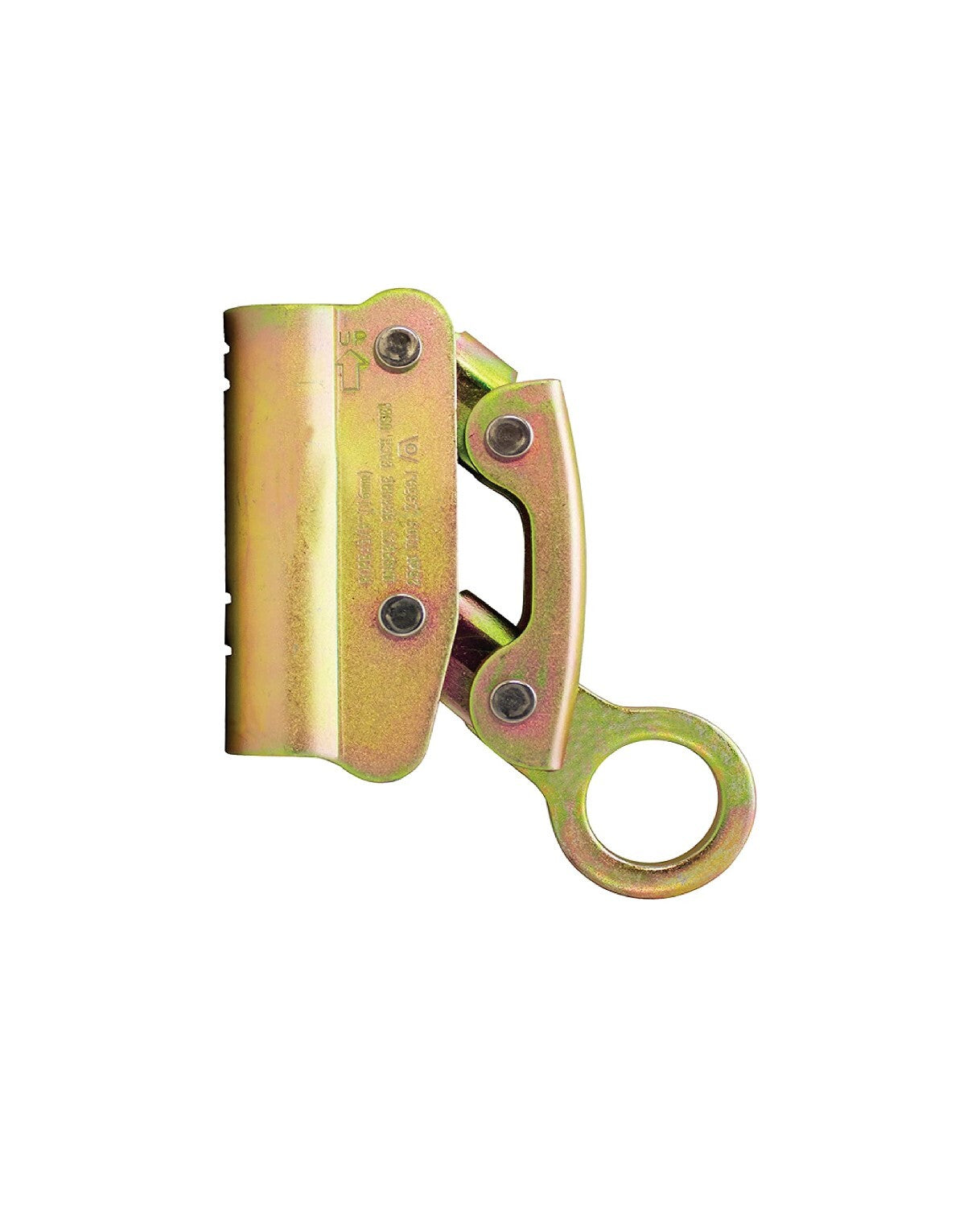
Rope Grab 5/8in Vertical Lifeline Trailing Fall Protection Contractor
Rope Grab 5/8in Vertical Lifeline Trailing Fall Protection Contractor
Couldn't load pickup availability
Rope Grab for 5/8" Vertical Lifeline — Trailing Fall Protection Device
5/8" Rope Compatible | Trailing Cam Design | Zinc Plated Steel | D-Ring Lanyard Attachment | OSHA/ANSI Compliant
Vertical Mobility Without Disconnection — The Device That Moves With the Worker and Locks When It Matters
Gutter contractors working on ladders and rooftops face a fundamental problem: fall protection that restricts movement slows down work, but disconnecting to reposition creates moments of unprotected exposure. The rope grab — also called a rope clamp, vertical lifeline grab, trailing fall arrester, rope fall arrester, and cable grab — solves this problem by providing continuous protection that moves with the worker. This trailing rope grab attaches to a 5/8-inch vertical lifeline and travels freely as the worker climbs up or down. The cam mechanism remains open during normal movement, allowing smooth travel along the rope. But when sudden downward force occurs — the signature of a fall — the cam instantly engages and locks onto the rope, arresting the fall. The zinc plated steel construction resists corrosion from weather exposure and job site conditions. The integrated D-ring provides the attachment point for connecting the worker's lanyard. For gutter installers, roofers, and general contractors who need fall protection while moving vertically on ladders, scaffolding, and structures, the trailing rope grab provides the mobility needed for productive work without the deadly gaps in protection that occur when repositioning fixed tie-offs. GutterAll supplies rope grabs to gutter contractors and general contractors throughout the Pacific Northwest and nationally from the Damascus, Oregon location.
5/8" Lifeline Compatible | Trailing Cam Design | Zinc Plated Steel | D-Ring Attachment | OSHA/ANSI Compliant
Key Benefits at a Glance
Moves with worker — no repositioning needed.
Cam engages automatically during fall.
Corrosion resistant for outdoor use.
Connects directly to lanyard or harness.
The Problem with Fixed Tie-Offs — And Why Trailing Protection Saves Time and Lives
Working at heights requires fall protection. But traditional fall protection creates a productivity problem: when a worker is tied off to a fixed anchor point with a lanyard, their working radius is limited to the lanyard length. Moving beyond that radius requires disconnecting, repositioning, and reconnecting. During those transitions, the worker is unprotected. On a ladder or roof, those unprotected moments are when falls happen.
Gutter contractors experience this problem constantly. Installing or cleaning gutters requires moving along the roof edge — sometimes the entire length of a building. Fixed tie-off points require constant repositioning, slowing work and creating dozens of unprotected transitions per job. Some contractors skip the repositioning and work unprotected beyond their lanyard radius. Others disconnect entirely and rely on balance alone. Both shortcuts invite the falls that kill construction workers every year.
The rope grab — also known as a rope clamp, vertical lifeline grab, trailing fall arrester, rope fall arrester, and cable grab — eliminates this problem. Combined with a vertical lifeline anchored at the top of the work area, the rope grab provides continuous fall protection that moves with the worker. The trailing cam mechanism allows the device to slide freely along the 5/8-inch rope during normal climbing movement. But when the cam senses the sudden acceleration of a fall, it engages instantly and locks onto the rope, stopping the descent. The worker never disconnects, never repositions, and never experiences an unprotected moment. Zinc plated steel construction withstands the corrosion that weather and job site conditions cause. The integrated D-ring provides a secure attachment point for connecting a shock absorbing lanyard to the worker's harness. For vertical work on ladders, scaffolding, and structures, the rope grab transforms fall protection from a series of tie-off-disconnect-reposition cycles into continuous, uninterrupted protection. GutterAll supplies rope grabs to gutter contractors and general contractors throughout the Pacific Northwest and nationally. Contact sales@gutterall.com for contractor pricing. Available for in-store pickup at 19759 SE Sunnyside Rd, Damascus, OR 97089, local delivery in the Portland metro area, or shipping to all 50 states.
| Product | Key Specifications |
|---|---|
| Rope Grab for 5/8" Vertical Lifeline | Trailing Cam Design | Zinc Plated Steel | D-Ring Attachment | OSHA/ANSI Compliant |
Why This Matters — What Unprotected Transitions Actually Cost
Falls from ladders and roofs are the leading cause of death in construction. The vast majority of these falls do not happen because workers refused to use fall protection — they happen during the moments between tie-offs when workers are transitioning and temporarily unprotected. A worker who conscientiously uses fall protection but disconnects to reposition is statistically most vulnerable during that transition. The rope grab eliminates transition vulnerability entirely.
Beyond the human cost, falls carry massive financial consequences: medical expenses, workers compensation claims, OSHA citations, insurance premium increases, litigation, and reputation damage. A single fall can bankrupt a small contracting business. The rope grab — costing a fraction of what a single workers comp claim costs — provides the continuous protection that eliminates the transition gaps where most falls occur. Professional contractors who understand this math equip their crews with vertical lifeline systems and rope grabs for any work requiring vertical movement at heights.
Trailing protection. Instant lock. Zinc plated steel. OSHA compliant.
Start a chat now or email sales@gutterall.com for contractor pricing.
Technical Explanation — How the Trailing Cam Mechanism Works
Cam Engagement Principle: The rope grab contains an internal cam — a rotating element with an eccentric profile. When the device moves slowly along the rope (normal climbing speed), the cam rotates freely and does not grip the rope. But when sudden downward acceleration occurs — the physics signature of a fall — inertia causes the cam to rotate into its locking position. The eccentric profile of the cam wedges against the rope, creating friction that increases as downward force increases. The harder the pull, the tighter the grip. This is fail-safe design: the mechanism locks not because of a spring or active component, but because of the physics of the fall itself.
Trailing vs. Manual Rope Grabs: Trailing rope grabs (like this unit) move with the worker automatically. Manual rope grabs require the worker to physically reposition the device by hand as they climb. Trailing designs are preferred for continuous climbing applications because they eliminate the need to stop and move the device. The trailing mechanism allows free movement in both directions (up and down) until fall forces engage the cam.
Zinc Plated Steel Construction: The rope grab body is steel with zinc plating — a corrosion-resistant coating that protects the device from rust in wet and humid conditions. Zinc plating is standard for outdoor safety equipment because it maintains strength while resisting the environmental degradation that uncoated steel experiences. The D-ring attachment point is integrated into the body, providing a secure connection for the shock absorbing lanyard that connects to the worker's harness.
Complete Vertical Lifeline System — Understanding the Components
| Component | Function | Requirements |
|---|---|---|
| Anchor Point | Secure attachment at top of work area | Must support 5,000 lbs per worker |
| Vertical Lifeline | Rope that runs from anchor to work area | 5/8" diameter for this rope grab |
| Rope Grab | Device that travels on rope and locks during fall | Must be compatible with lifeline diameter |
| Shock Absorbing Lanyard | Connects rope grab to harness; absorbs energy | Limits arrest force to 1,800 lbs max |
| Full Body Harness | Distributes arrest forces across worker | Must have dorsal D-ring for fall arrest |
Rope Grab Types Compared — Trailing vs. Manual Designs
| Type | How It Works | Best Applications |
|---|---|---|
| Trailing Rope Grab (This Unit) | Moves automatically with worker; no repositioning | Continuous climbing, ladder work, scaffolding access |
| Manual Rope Grab | Worker repositions device by hand | Fixed position work, infrequent repositioning |
| Self-Retracting Lifeline (SRL) | Retracts cable like seatbelt; locks on sudden pull | Horizontal mobility, overhead anchor applications |
| Fixed Lanyard | Static connection to anchor; limited radius | Single position work, short duration tasks |
Work Applications — Where Rope Grabs Solve Problems
Rope grabs provide vertical fall protection for applications where workers need to move up and down while staying protected:
| Application | The Challenge | Why It Helps |
|---|---|---|
| Ladder Access to Roofs | Worker climbs ladder to access roof edge | Continuous protection during entire climb |
| Multi-Story Gutter Work | Worker moves between levels on scaffold or ladder | No disconnection needed when changing levels |
| Steep Slope Roofing | Worker moves up and down roof face | Rope grab trails with movement, locks on slip |
| Scaffold Tower Climbing | Worker ascends/descends scaffold structure | Vertical lifeline provides protection during climb |
| Fixed Ladder Systems | Worker climbs permanent ladders on structures | Rope grab on vertical lifeline provides backup |
Trailing Cam Design. Zinc Plated Steel. D-Ring Attachment. 5/8" Lifeline Compatible.
Start a chat for fastest response or email sales@gutterall.com
Key Features and User Benefits
| Feature | Technical Detail | Contractor Benefit |
|---|---|---|
| Trailing Cam Design | Moves freely on rope; locks on sudden force | No repositioning needed during climbing |
| 5/8" Rope Compatibility | Fits standard 5/8" diameter vertical lifelines | Compatible with common lifeline systems |
| Zinc Plated Steel | Steel body with zinc coating | Corrosion resistant for outdoor job sites |
| D-Ring Attachment | Integrated attachment point | Connects directly to lanyard or carabiner |
| Automatic Locking | Cam engages on fall forces | No user action required to arrest fall |
| OSHA/ANSI Compliant | Meets federal and industry standards | Regulatory compliance for job sites |
The Rope Grab for 5/8" Vertical Lifeline — also known as a rope clamp, vertical lifeline grab, trailing fall arrester, rope fall arrester, and cable grab — provides continuous fall protection for workers who need to move vertically while staying protected. The trailing cam design allows the device to move freely along the 5/8-inch diameter vertical lifeline during normal climbing, eliminating the need to stop and reposition. When fall forces occur, the cam engages instantly and locks onto the rope to arrest the descent. Zinc plated steel construction resists the corrosion that weather and job site conditions cause, maintaining structural integrity over years of outdoor use. The integrated D-ring provides the attachment point for connecting a shock absorbing lanyard to the worker's harness, completing the connection between worker and lifeline. For gutter contractors, roofers, and general contractors who work at heights requiring vertical movement, the rope grab eliminates the dangerous transition gaps that occur with fixed tie-off systems. Combined with a properly anchored vertical lifeline and shock absorbing lanyard, the rope grab provides the continuous protection that OSHA requires for work at heights. GutterAll supplies rope grabs to gutter contractors and general contractors throughout the Pacific Northwest and nationally. Contact sales@gutterall.com for contractor pricing on quantity orders. Available for in-store pickup at 19759 SE Sunnyside Rd, Damascus, OR 97089, local delivery in the Portland metro area, or shipping to all 50 states. Monday through Friday 7am to 4pm, Saturday 8am to 12pm PST.
Why Contractors Use Rope Grabs:
- Continuous Protection: No disconnection required during vertical movement
- Trailing Design: Moves with worker automatically
- Instant Lock: Cam engages automatically on fall
- Zinc Plated Steel: Corrosion resistant for outdoor use
- 5/8" Compatibility: Fits standard vertical lifelines
- D-Ring Attachment: Connects to lanyard or carabiner
- OSHA Compliant: Meets federal fall protection standards
- ANSI Rated: Meets industry safety standards
- Productivity Increase: No stopping to reposition
- Transition Safety: Eliminates unprotected moments
- Ladder Applications: Ideal for roof access climbing
- Scaffold Climbing: Protection during vertical access
- Bidirectional Travel: Works climbing up or down
- Durable Construction: Steel body withstands job site use
- Local Pacific NW Stock: Available from Damascus, Oregon
Product Specifications
| Product Name | Rope Grab for 5/8" Vertical Lifeline |
| Product Type | Rope Grab / Rope Clamp / Vertical Lifeline Grab / Trailing Fall Arrester / Rope Fall Arrester / Cable Grab |
| Supplier | GutterAll, 19759 SE Sunnyside Rd, Damascus, OR 97089 |
| Rope Compatibility | 5/8 inch (16mm) diameter vertical lifeline |
| Grab Type | Trailing — moves with worker automatically |
| Locking Mechanism | Cam-actuated — locks automatically on fall forces |
| Body Material | Steel — zinc plated for corrosion resistance |
| Finish | Zinc plated (yellow/gold cadmium appearance) |
| Attachment Point | Integrated D-ring for lanyard connection |
| Minimum Breaking Strength | 5,000 lbs (standard for fall arrest components) |
| Regulatory Compliance | OSHA 1926.502 | ANSI Z359.1 |
| Weight Capacity | 130 lbs to 310 lbs (worker plus tools) |
| Lifeline Connection | Threads onto 5/8" vertical lifeline rope |
| Lanyard Requirements | Shock absorbing lanyard required for fall arrest |
| Harness Requirements | Full body harness with dorsal D-ring |
| Primary Applications | Ladder climbing | Scaffold access | Roof access | Vertical structure work |
| Expected Service Life | Inspect before each use per manufacturer guidelines. Remove from service if cam mechanism fails to operate smoothly, if zinc plating shows significant damage, or if device has arrested a fall. Replace if body shows cracks, deformation, or corrosion. |
| Fulfillment Options | Nationwide Shipping (all 50 states) | Local Delivery (Portland metro) | In-Store Pickup (Damascus, OR) |
Who Uses Rope Grabs
Gutter Installation Contractors (Primary)
- Ladder access to roof edges
- Multi-story gutter installations
- Scaffold climbing during commercial work
- Roof access for fascia and soffit work
- Vertical movement on steep structures
- Crew fall protection systems
Why it matters: Gutter contractors climb ladders constantly. The rope grab on a vertical lifeline provides continuous protection during the climb — no unprotected transitions when moving between ladder and roof.
Roofing Contractors (Primary)
- Steep slope roof work
- Roof access via ladder systems
- Multi-level roofing projects
- Commercial building access
- Tower and structure climbing
- Vertical work on building exteriors
Why it matters: Roofers working on steep slopes use vertical lifelines and rope grabs to stay protected while moving up and down the roof face — protection that moves with them rather than restricting their work radius.
General Contractors (Secondary)
- Scaffold tower climbing
- Fixed ladder systems
- Building exterior work
- Window and siding installation
- HVAC equipment access
- General vertical access needs
Why it matters: Any contractor with workers climbing ladders, scaffolds, or structures needs vertical fall protection. The rope grab provides the mobile protection that keeps workers safe during vertical movement.
Usage Guide — Rope Grab for 5/8" Vertical Lifeline
- Inspect before each use: Check rope grab body for cracks, corrosion, or deformation. Verify cam moves freely and locks when tested. Inspect D-ring for wear or damage. Check zinc plating for significant deterioration.
- Verify lifeline compatibility: Confirm vertical lifeline is 5/8" diameter and in good condition. Check that lifeline is properly anchored at top with anchor rated for 5,000 lbs per worker.
- Install rope grab on lifeline: Open the rope grab mechanism per manufacturer instructions. Thread the 5/8" lifeline through the device. Close and secure the mechanism. Verify it travels freely on the rope.
- Connect shock absorbing lanyard: Attach a shock absorbing lanyard to the rope grab D-ring using a compatible connector. The lanyard is required to limit arrest forces during a fall event.
- Connect to harness: Attach the other end of the lanyard to the dorsal D-ring on the worker's full body harness. Verify all connections are secure and locked.
- Verify trailing function: Move the rope grab up and down the lifeline by hand. It should travel freely in both directions. Pull sharply downward — the cam should engage and lock.
- Position rope grab above work area: Before climbing, position the rope grab at or above head height on the lifeline. This minimizes potential fall distance.
- Climb while maintaining rope grab position: As you climb, the trailing rope grab should follow. Periodically verify it is tracking properly and has not become stuck or jammed.
- Remove from service after fall: If the rope grab has arrested a fall, remove it from service immediately. Have it inspected by a competent person before returning to use.
- Store properly: When not in use, store rope grab in dry location away from chemicals, oils, and direct sunlight. Protect from physical damage during transport and storage.
Trailing Cam Design. Zinc Plated Steel. 5/8" Lifeline Compatible. OSHA Compliant.
Start a chat for fastest response or email sales@gutterall.com.
Mon-Fri 7am-4pm | Sat 8am-12pm PST | (503) 850-6784
Frequently Asked Questions
What rope diameter does this rope grab require? +
What is the difference between trailing and manual rope grabs? +
Do I need a shock absorbing lanyard with a rope grab? +
What is the return policy? +
How does shipping work? +
Is contractor volume pricing available? +
Critical Safety Notice
THIS IS LIFE SAFETY EQUIPMENT. IMPROPER USE CAN RESULT IN SERIOUS INJURY OR DEATH. Use only with 5/8" diameter vertical lifelines — other diameters may not lock properly. Inspect before each use — remove from service if cam does not operate smoothly or lock securely. Use only with shock absorbing lanyard and full body harness. Anchor lifeline at top to point rated for 5,000 lbs per worker. Test locking function before each use by pulling sharply on rope below device. Remove from service after any fall event. Training in proper use is required before use. Follow all manufacturer instructions and OSHA regulations.
Order Rope Grab for 5/8" Vertical Lifeline — Trailing Fall Protection
Trailing cam design. Zinc plated steel construction. D-ring lanyard attachment. 5/8" lifeline compatible. OSHA and ANSI compliant.
Add to Cart
Nationwide shipping | Local delivery | In-store pickup available
Volume orders and contractor pricing: sales@gutterall.com
Mon-Fri 7am-4pm | Sat 8am-12pm PST | (503) 850-6784
Rope Grab for 5/8" Vertical Lifeline — At a Glance
Trailing Cam Design. Zinc Plated Steel. D-Ring Attachment. 5/8" Lifeline Compatible. OSHA/ANSI Compliant. Continuous Vertical Protection.
GutterAll — Professional Gutter Tools and Safety Equipment
Damascus, OR 97089
Sat: 8am-12pm PST