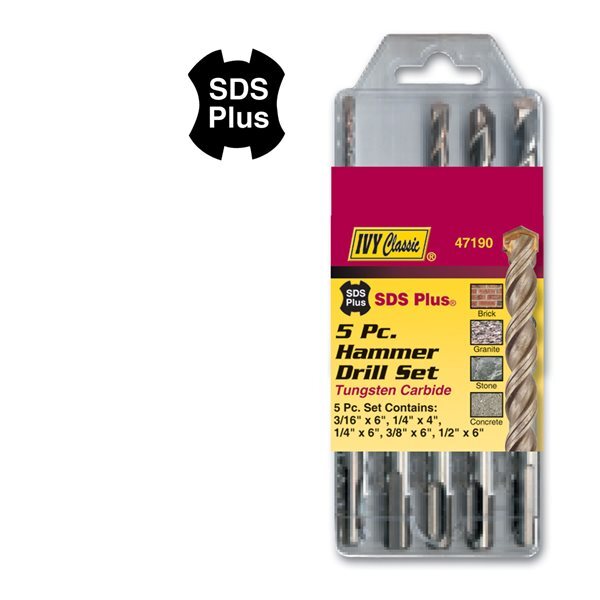
IVY Classic 47190 SDS Plus Hammer Drill Bit Set 5-Pc Carbide
IVY Classic 47190 SDS Plus Hammer Drill Bit Set 5-Pc Carbide
Couldn't load pickup availability
IVY Classic 47190 — SDS Plus 5-Piece Hammer Drill Bit Set, Tungsten Carbide
SDS Plus Shank | Tungsten Carbide Tips | Parabolic Flute | Copper-Silver Brazed | 5-Piece Set | 3/16" · 1/4" · 3/8" · 1/2" Diameters | Brick · Concrete · Granite · Stone
The Drill Bit Set That Puts Gutter Hanger Anchors Exactly Where They Need to Go
Every gutter installation that terminates at a masonry fascia, concrete block foundation wall, brick chimney cap, or natural stone surface requires a clean, accurate pilot hole. The wrong drill bit — one with a plain carbon steel tip, an incompatible shank, or a narrow flute that cannot clear debris — results in overheated bits, off-center holes, split anchor inserts, and loose gutter hangers that fail in the first heavy rain. The IVY Classic 47190 is a 5-piece SDS Plus hammer drill bit set built with tungsten carbide tips, copper-silver brazed heads, and a parabolic flute geometry designed to remove masonry debris from the bore hole continuously as the bit advances. Available in five sizes from 3/16" to 1/2", it covers the full diameter range of the masonry anchors, tapcon screws, lead expansion shields, and drive anchors that gutter installers drive into concrete, brick, granite, and stone every day.
SDS Plus | Tungsten Carbide | Parabolic Flute | 5 Sizes | Ships from Damascus, OR
Key Benefits at a Glance
Harder than the aggregate in concrete and the silica in granite — carbide tips stay sharp through the extended hammer drilling that masonry anchor placement in gutter installation demands, without the rapid edge breakdown that plain carbon steel tips experience in the same material.
Bayonet-style SDS Plus shank locks into any SDS Plus rotary hammer with secure bit retention that prevents bit pullout under repeated hammering cycles — not a standard round or hex shank that relies on chuck friction and backs out under sustained impact load.
The curved parabolic flute geometry continuously removes masonry dust and aggregate from the bore hole as the bit advances — keeping the cutting zone clear, reducing heat buildup from trapped debris, and enabling faster, cleaner holes in all four materials the set is rated for.
3/16"x6", 1/4"x4", 1/4"x6", 3/8"x6", and 1/2"x6" in a single retail set — the diameter and depth range that covers tapcon fasteners, lead shields, sleeve anchors, drive anchors, and wedge anchors used across the full gutter system installation scope.
Masonry Anchor Drilling Done Right — Why Bit Specification Determines Installation Quality
In gutter installation, most of the cutting work is handled by tin snips and utility knives — but when the job terminates at a masonry surface, nothing moves forward until a proper hole is in the wall. Gutter installers setting expansion shields for fascia-mounted hangers on concrete block, driving tapcon screws into poured concrete foundations, anchoring aluminum downspout brackets into brick, or securing gutter spikes through stucco into the structural wythe behind it all need the same thing: a clean, on-diameter bore hole drilled to the correct depth without spalling the surface around the entrance or overheating the bit mid-hole.
This requires three things simultaneously: a tip material harder than the substrate being drilled (tungsten carbide versus concrete aggregate, granite, or brick clay), a shank system that transfers hammer energy without bit pullout (SDS Plus versus standard chuck), and a flute geometry that removes debris continuously rather than packing it into the bore hole (parabolic versus straight flute). The IVY Classic 47190 provides all three — and does so in the five sizes that cover the anchor and fastener diameter range gutter installers encounter from small-diameter tapcon pilots on block foundations to 1/2" sleeve anchor bores in poured concrete lintels. An SDS Plus rotary hammer drill — also called a rotary hammer, hammer drill, or SDS drill — is required to use this set.
GutterAll in Damascus, Oregon carries the IVY Classic 47190 SDS Plus hammer drill bit set — also known in the trades as a masonry bit set, carbide masonry drill set, SDS bit set, rotary hammer bit set, and concrete drill bit set — as part of its professional gutter installation supply inventory. Orders ship nationwide from Damascus. Local delivery is available for contractors in the greater Portland metro area, and in-store pickup is available at the Damascus location.
| Model | Set Size | Shank | Tip Material | Bit Sizes Included |
|---|---|---|---|---|
| 47190 | 5 Piece | SDS Plus | Tungsten Carbide — Copper-Silver Brazed | 3/16"x6" | 1/4"x4" | 1/4"x6" | 3/8"x6" | 1/2"x6" |
Five sizes. Carbide tips. SDS Plus shank. Add to cart and have it shipped from Damascus, OR.
Crew orders and bulk quantities: sales@gutterall.com
Why Masonry Drilling Capability Is a Standard Requirement for Full-Service Gutter Installers
A gutter installation crew that can only work on wood fascia is a crew that turns away jobs. Residential construction in the Portland metro and throughout the Pacific Northwest regularly includes homes with exposed concrete block gable ends, brick chimney caps with gutter termination points, poured concrete lintels above garage doors where downspouts anchor, stucco over masonry substrates, and natural stone veneer where hanger brackets must penetrate to the substrate. Every one of these surfaces requires a masonry bit — and it requires a carbide-tipped SDS Plus bit specifically, because carbon steel tips overheat and fail in the hammer drilling cycle, and standard chuck bits back out under the impact energy a rotary hammer produces. The IVY Classic 47190 covers the five bit sizes that encompass the standard fastener range for gutter hanger anchors, downspout bracket expansion shields, and gutter spike lead shields — which means one set covers the anchor drilling scope across the full range of masonry substrates a gutter installer encounters. A crew that carries this set on every truck does not turn down masonry jobs, does not delay for a bit run mid-installation, and does not lose anchor holes to bit failure.
Gutter Installer and Cleaner Applications
The IVY Classic 47190 addresses five specific masonry drilling tasks that arise on gutter installation and cleaning jobs where the substrate is not wood:
| Gutter Application | The Masonry Challenge | Why It Helps |
|---|---|---|
| Gutter Hanger Anchor Drilling — Concrete Block and CMU | Drilling pilot holes for tapcon fasteners and sleeve anchors into concrete masonry unit (CMU) block walls and poured concrete fascia — a substrate that destroys carbon steel bits within 2 to 3 holes under hammer drill impact | Tungsten carbide tip withstands the compressive hardness of CMU and poured concrete; SDS Plus shank locks in the hammer drill chuck under repeated impact cycles; parabolic flute clears concrete dust to prevent thermal buildup mid-hole |
| Downspout Bracket Anchoring — Brick Veneer and Full-Brick | Setting lead expansion shields, sleeve anchors, or tapcon masonry screws into clay brick for downspout strap bracket mounting — brick's fired clay silica content is highly abrasive to drill tips and the mortar joint interface creates variable hardness across the drill path | The 1/4"x4", 1/4"x6", and 3/8"x6" sizes cover the standard sleeve anchor and lead shield diameter range for brick downspout anchor applications; carbide tip handles the silica abrasion in fired clay that degrades standard masonry bits within a single anchor set |
| Chimney Cap Gutter Termination — Granite and Natural Stone | Drilling anchor holes for gutter termination brackets into natural stone chimney caps, granite lintels, and stone veneer facade elements — natural stone with high quartz content is the most demanding masonry drilling substrate and rapidly destroys standard carbide tips from import-grade bit sets | IVY Classic tungsten carbide tips are rated for granite on the retail packaging — confirmed drill application for the stone and granite substrates gutter installers encounter at chimney terminations; copper-silver brazing retains the tip under the elevated heat that granite drilling generates |
| Stucco Over Masonry Substrate Penetration | Penetrating stucco finish coats over concrete block, brick, or poured concrete substrates to set gutter hanger anchors and downspout bracket fasteners — requires a bit that penetrates the stucco skin without spalling the surface face, then continues cleanly into the substrate beneath | The 3/16"x6" starter size provides a clean pilot entry through the stucco face without crack propagation; larger sizes follow the same pilot path for anchor expansion without surface spalling; parabolic flute clears the mixed debris of stucco and substrate aggregate continuously |
| Gutter Replacement — Anchor Relocation on Legacy Masonry | Re-drilling anchor positions for replacement gutter runs where original holes must be shifted to undamaged masonry — legacy poured concrete and older brick often has higher density than modern equivalents and requires a bit that can sustain drilling performance across 20 to 30 anchor placements per job | The 5-piece set provides both the 3/16" pilot and the 1/4", 3/8", 1/2" finish sizes needed for the full anchor diameter range on a replacement run; tungsten carbide edge retention sustains performance through the high anchor count that a full gutter replacement requires |
SDS Plus Shank — Why the Bit Retention System Determines Hammer Drilling Performance
SDS Plus — an abbreviation for Steck-Dreh-Sitzt (German: insert-twist-seated) in its original form, and widely recognized in the North American trades as the standard bayonet hammer drill shank system — uses two open grooves and two closed slots in the bit shank that engage corresponding lugs inside the hammer drill chuck. This design allows the bit to slide axially (hammering motion) while remaining locked rotationally (drilling motion), which is what a rotary hammer requires. A standard keyed or keyless chuck grips the bit by friction; under sustained hammer impact, that friction grip fails and the bit backs out of the hole. The SDS Plus shank cannot back out because the locking lugs engage physically, not by friction. For gutter installers drilling anchor holes in concrete or brick from a ladder position — where repositioning the drill to re-seat a backed-out bit is a genuine productivity and safety issue — SDS Plus bit retention is not a marketing feature; it is a functional requirement.
Tungsten Carbide Tips — Material Science Behind Masonry Drilling Edge Retention
Tungsten carbide is a cemented carbide compound — tungsten and carbon — sintered to a hardness of approximately 9 to 9.5 on the Mohs scale, which places it harder than quartz (7), feldspar (6), and the aggregate and silica compounds found in concrete, brick, and granite. When a tungsten carbide tip contacts concrete aggregate or granite quartz, the carbide outlasts the substrate at the contact point, which is what produces a clean bore hole rather than a crushed, overheated entry. Carbon steel drill tips, by comparison, are softer than the aggregate they contact — which is why carbon steel masonry bits heat rapidly, lose their geometry within a few holes, and produce wandering, oversized bore holes that cause expansion anchors to seat loose. The IVY Classic 47190 uses copper-silver brazing to bond the carbide tip to the steel bit body — a brazing alloy rated for the elevated temperatures that occur during extended hammer drilling in hard stone and granite, where tip separation under thermal stress is the primary failure mode for lower-quality carbide bits with standard solder bonding.
Parabolic Flute Geometry — Continuous Debris Evacuation During the Drill Cycle
A parabolic flute is a spiral groove cut into the bit body with a curved cross-section — wider at the root, tighter at the leading edge — that creates an efficient auger geometry for masonry debris. As the bit rotates and advances into concrete, brick, or stone, the hammer action pulverizes the material ahead of the carbide tip into dust and fine aggregate fragments. Without an efficient flute, this debris packs into the bottom of the bore hole, increasing drill resistance, elevating heat at the tip, and compressing the hole walls — which produces oversize bore holes that compromise anchor holding strength. The parabolic flute geometry continuously draws debris up and out of the bore hole as the bit advances, keeping the cutting zone clear, reducing thermal load on the carbide tip, and enabling the consistent hole diameter that anchor specifications require. This is the design difference between a masonry bit that produces 20 clean anchor holes and one that degrades to producing unusable holes by the eighth or ninth bore in hard concrete.
The 5 Included Sizes — Which Anchor and Fastener Each Bit Supports
3/16" x 6"
Tapcon screw pilot — 3/16" dia. concrete screw standard pilot; stucco skin entry; starter pilot for step drilling
1/4" x 4"
1/4" tapcon pilot; 1/4" lead shield / lag shield for hanger screws; short-depth anchor bores in thin masonry elements
1/4" x 6"
1/4" anchor bore at full-depth — sleeve anchors, drive anchors, and lead shields requiring 2" or greater embedment in CMU and poured concrete
3/8" x 6"
3/8" sleeve anchor and wedge anchor bores for through-wall downspout bracket anchors and heavy-duty gutter hanger applications
1/2" x 6"
1/2" wedge anchor and sleeve anchor bores for large-diameter masonry fasteners; lag shield for commercial-grade downspout and conductor head anchors
Key Features and Gutter Installer Benefits
| Feature | Construction Detail | Gutter Installer Benefit |
|---|---|---|
| Tip Material | Tungsten Carbide | Drills concrete, brick, granite, and stone substrates where gutter hanger anchors terminate — harder than the aggregate in all four materials, maintaining bit geometry across the full anchor count of a typical installation job |
| Tip Bonding | Copper-Silver Brazed | Retains the carbide tip under elevated drilling temperatures — important in granite and dense poured concrete where tip separation from thermal stress is the primary failure mode for lower-quality carbide masonry bits under sustained hammer drill use |
| Shank System | SDS Plus Bayonet | Locks into any SDS Plus rotary hammer with physical lug retention — bit cannot back out of the chuck under sustained hammer impact the way a standard friction-chuck bit does, maintaining position accuracy on all anchor holes including those drilled from ladder height |
| Flute Design | Parabolic Spiral | Continuously evacuates masonry debris from the bore hole as the bit advances — keeps the cutting zone clear of packed dust that would otherwise increase thermal load, reduce drilling speed, and produce oversized holes that weaken anchor holding strength |
| Size Range | 3/16" through 1/2" — Five Sizes | Covers the complete fastener diameter range from 3/16" tapcon pilots to 1/2" sleeve anchor bores — one set handles the full anchor scope of residential and light-commercial gutter installation on masonry substrates without requiring additional individual bit purchases |
| Rated Substrates | Brick, Concrete, Granite, Stone | Covers all four masonry substrate types encountered in gutter installation on residential and commercial structures — no need to determine if a different bit set is required for granite versus concrete; one set, rated for all four |
The IVY Classic 47190 SDS Plus 5-piece hammer drill bit set — also known in the trades as a masonry drill bit set, SDS bit set, carbide drill set, rotary hammer bit set, and concrete bit set — is the professional-grade anchor drilling solution for gutter installation crews who work on concrete, brick, granite, and stone substrates. Tungsten carbide tips bonded with copper-silver brazing, parabolic flute geometry for continuous debris evacuation, and SDS Plus shank retention that cannot back out under hammer impact make this set the correct specification for the anchor work that gutter installation on masonry surfaces demands. GutterAll in Damascus, Oregon stocks the IVY Classic 47190 as part of its full gutter installation supply inventory and ships it nationwide. Email sales@gutterall.com for crew quantity pricing or to add drill bits to an existing installation supply order. Monday through Friday 7am to 4pm, Saturday 8am to 2pm PST.
Why Gutter Crews Specify the IVY Classic 47190:
- Tungsten Carbide Tips: Outlast the aggregate in concrete, the silica in granite, and the fired clay in brick — maintaining bit geometry and bore hole diameter across more anchor holes than carbon steel tips under the same hammer drill conditions
- Copper-Silver Brazing: High-temperature brazing alloy retains the carbide tip under the thermal stress of extended drilling in granite and hard stone — prevents tip separation, which is the primary failure mode for lower-quality carbide masonry bits
- SDS Plus Shank: Bayonet lug retention prevents bit pullout under sustained hammer impact — bit stays fully seated through every anchor hole on the job, including those drilled from extended ladder positions
- Parabolic Flute: Continuously evacuates masonry dust and debris from the bore hole as the bit advances — reduces thermal buildup, maintains drilling speed, and produces on-diameter holes that seat anchors at rated holding strength
- 3/16" Tapcon Pilot Size: The most-used size in residential gutter hanger installation — correct pilot diameter for 3/16" and standard tapcon concrete screws in block and poured concrete fascia applications
- 1/4" in Two Lengths: The 1/4"x4" and 1/4"x6" cover shallow and full-embedment anchor bores for lead shields, lag shields, and 1/4" sleeve anchors — the standard range for downspout bracket and hanger anchor applications
- 3/8" Anchor Bore Coverage: The 3/8"x6" handles the sleeve anchor and wedge anchor diameter range for heavier-duty bracket mounting and commercial-grade gutter hanger applications
- 1/2" Heavy Anchor Coverage: The 1/2"x6" covers large-diameter wedge and sleeve anchors for structural downspout conductor head brackets and heavy commercial gutter hanger loads
- Four Rated Substrates: Brick, concrete, granite, and stone — covers every masonry substrate type encountered in residential and commercial gutter installation without substituting bit sets by material
- Broad Hammer Drill Compatibility: Fits any SDS Plus rotary hammer — Bosch, Makita, Milwaukee, DeWalt, Hilti, Metabo, and all other SDS Plus platform rotary hammers already in use by gutter installation crews
- 5-Piece Crew Set: All five sizes in a single retail pack — complete masonry anchor drilling range from one purchase, one shipment, one item number stocked on every service truck
- Concrete Block and CMU Applications: Drills CMU block with the impact energy and tip hardness required to penetrate the high-aggregate content of modern block production without bit failure mid-hole
- Brick and Mortar Joint Applications: Carbide tip handles the variable hardness transition from brick face to mortar joint and back to brick — maintaining straight bore alignment through the joint without the bit walking that occurs with worn tips
- Prevents Mid-Job Bit Failure: Copper-silver brazed carbide tips sustained through the full anchor count of a typical gutter replacement job — no bit failure stoppages, no bit run to the supply house mid-installation
- Expanded Job Scope: A crew equipped with the IVY Classic 47190 on every service truck can take masonry substrate gutter jobs that a crew without proper SDS Plus carbide bits must turn down or delay pending tool procurement
Product Specifications
| Product Type | SDS Plus Hammer Drill Bit Set — Masonry Drilling |
| Brand | IVY Classic |
| Model Number | 47190 |
| Set Size | 5 Piece |
| Bit Sizes Included | 3/16" x 6" | 1/4" x 4" | 1/4" x 6" | 3/8" x 6" | 1/2" x 6" |
| Shank Type | SDS Plus (Steck-Dreh-Sitzt Plus) — Bayonet Lug Retention |
| Tip Material | Tungsten Carbide |
| Tip Bonding Method | Copper-Silver Brazing — High-Temperature Thermal Resistance |
| Flute Design | Parabolic Spiral — Continuous Debris Evacuation |
| Rated Drill Materials | Brick | Concrete | Granite | Stone |
| Required Tool | SDS Plus Rotary Hammer Drill — not compatible with standard keyed or keyless chuck drills |
| Primary Trade Applications | Gutter installation, masonry construction, concrete anchoring, renovation, roofing, general building trades |
| Expected Service Life | Masonry hammer drill bits are consumable cutting tools replaced as the carbide tip wears. Tungsten carbide tips with copper-silver brazing provide significantly longer service life per bit than carbon steel masonry bits under equivalent SDS Plus hammer drilling conditions in concrete, brick, granite, and stone. |
| Fulfillment Options | Ships nationwide | Local delivery | In-store pickup — Damascus, OR |
Who Specifies the IVY Classic 47190
Gutter Installers and Cleaners (Primary)
- Drilling tapcon and concrete screw pilots in block and poured concrete fascia for gutter hanger anchors
- Setting lead shields and lag shields in brick for downspout strap bracket mounting
- Anchoring hanger brackets into granite lintels and natural stone chimney terminations
- Penetrating stucco-over-masonry substrates for hanger and bracket anchor placement
- Re-drilling anchor positions during gutter replacement on legacy masonry structures
- Boring sleeve anchor holes for commercial-grade gutter hanger and conductor head bracket applications
Why it matters: Gutter installation on masonry substrates requires bits that can sustain performance through 15 to 30 anchor hole placements per job in concrete, brick, and stone without tip failure or bore hole diameter loss — which is what separates tungsten carbide SDS Plus bits from the standard masonry bits that degrade within the first two to three holes in hard masonry.
Roofing, Masonry, and General Contractors (Secondary)
- Anchoring roof flashing and drip edge to masonry parapet walls and concrete block parapets
- Setting anchor bolts for structural steel connections into poured concrete
- Mounting handrail brackets and site safety equipment to masonry walls on construction sites
- Drilling anchor holes for mechanical, electrical, and plumbing penetrations through concrete block
- Installing expansion anchors for HVAC equipment mounting brackets on masonry substrates
- General construction anchor drilling across residential and commercial masonry applications
Why it matters: Any trade application that requires clean, on-diameter anchor holes in concrete, brick, granite, or stone at high daily hole counts requires the carbide tip hardness, SDS Plus retention, and parabolic debris evacuation that separates professional masonry bit sets from consumer-grade alternatives.
Setup and Application Guide — Using the IVY Classic 47190 for Masonry Anchor Drilling on Gutter Jobs
- Confirm tool compatibility before use: The IVY Classic 47190 requires an SDS Plus rotary hammer drill. Do not attempt to use these bits in a standard keyed or keyless chuck drill — the SDS Plus shank will not seat correctly in a standard chuck and the bit will not be retained under hammer impact. Confirm the hammer drill on the truck is an SDS Plus platform (not SDS Max) before loading bits.
- Select the correct bit size for the anchor being installed: Match the bit diameter to the specific anchor or fastener manufacturer's required pilot hole diameter. For tapcon concrete screws, use the pilot diameter specified on the tapcon packaging — typically 3/16" or 1/4". For sleeve anchors and wedge anchors, use the bit diameter that matches the anchor body diameter. Using an incorrect diameter produces a hole that either grips the anchor too tightly (causing shear stress during driving) or seats the anchor loose (reducing rated holding strength).
- Load the bit into the SDS Plus chuck: Retract the SDS Plus chuck collar and insert the bit shank fully until the locking lugs engage. Release the collar and confirm the bit is locked — tug outward on the bit; it should slide axially (approximately 1/4" of free play is normal and by design) but not pull out of the chuck. A bit that pulls fully free was not fully inserted.
- Mark anchor hole locations before drilling: Use a combination square, chalk line, or level to mark anchor positions before starting the drill. On masonry, repositioning a hole that was drilled in the wrong location requires patching the bore — marking all positions correctly the first time eliminates this rework.
- Set the hammer drill to the correct mode: For concrete, brick, and stone, set the hammer drill to hammer-and-rotate (rotary hammer) mode — not rotation-only. Rotation-only mode does not activate the hammer mechanism and will overheat the carbide tip rapidly on hard masonry. SDS Plus drills typically have a mode selector between rotation-only, hammer-and-rotate, and chisel-only positions.
- Begin drilling with steady, moderate pressure: Start the hole with steady axial pressure aligned perpendicular to the masonry surface. Avoid side pressure on the bit during the first quarter inch of drilling — the bore hole entry is the most critical point for maintaining perpendicularity and preventing surface spalling around the anchor hole entrance. On brick, avoid drilling directly on the mortar joint where possible; drill into the brick body for maximum anchor holding strength.
- Withdraw the bit periodically to clear debris: On holes deeper than 2 inches, withdraw the bit completely every inch or so to allow the parabolic flute to fully evacuate the bore hole. Do not rely solely on the flute for debris removal in deep holes — periodic withdrawal clears accumulated debris at the bottom of the hole and prevents thermal buildup at the tip. In granite specifically, pull back every inch to maintain tip temperature at a safe operating level.
- Verify hole depth before setting the anchor: Use a depth stop on the hammer drill if available, or mark the required depth on the bit shank with tape. Set the anchor only into a hole drilled to the manufacturer's specified minimum embedment depth. Insufficient depth prevents the anchor from reaching its rated holding capacity — the anchor may appear seated but will fail under load.
- Blow out the bore hole before anchor installation: Use a blow bulb or compressed air to clear masonry dust from the bore hole immediately before inserting the anchor. Packed dust in the bore hole reduces anchor contact with the hole walls and prevents proper expansion — most masonry anchor manufacturers specify a clean bore hole as a condition of rated holding strength, and some anchor adhesive systems require a clean, dust-free hole as a prerequisite for adhesive cure.
- Inspect and change bits when drilling speed degrades: When a bit that previously drilled a hole in 20 to 30 seconds begins taking 60 seconds or more in the same material, the carbide tip has worn to the point where the cutting geometry is compromised. Continue using a worn bit and the bore holes it produces will be oversized, the drilling heat will increase, and anchor holding strength in those holes will be reduced. Change to a fresh bit before drilling degrades further, and mark the worn bit for discard rather than returning it to the bit set.
Five sizes. Carbide tips. Every masonry substrate gutter installers face — covered.
Select quantity and add to cart. Ships from Damascus, OR. Email sales@gutterall.com for crew and bulk pack pricing.
Frequently Asked Questions
Q: What hammer drill is required to use the IVY Classic 47190, and does it fit all brands?
The IVY Classic 47190 requires an SDS Plus rotary hammer drill — it will not work in a standard keyed or keyless chuck drill because the SDS Plus shank will not seat correctly in a standard chuck. SDS Plus is an industry-standard shank system, and the 47190 bits are compatible with SDS Plus rotary hammers from all major tool brands including Bosch, Makita, Milwaukee, DeWalt, Hilti, Metabo, and Ridgid, as well as all other hammer drills that accept the SDS Plus platform. Verify that the hammer drill on the truck has an SDS Plus chuck before ordering — not SDS Max, which uses a larger-diameter shank and is not compatible.
Q: Which bit size in the set should be used for standard tapcon concrete screws in gutter hanger installation?
The most commonly used tapcon concrete screws for gutter hanger applications require either a 3/16" or 1/4" pilot hole — both sizes are included in the IVY Classic 47190 set. The specific required pilot hole diameter is specified on the tapcon fastener packaging and must match the tapcon diameter selected for the anchor application. The 3/16"x6" bit covers standard 3/16" tapcon pilots in block and poured concrete; the 1/4"x4" and 1/4"x6" cover 1/4" tapcon and lead shield pilots at shallow and full-embedment depths respectively. Always verify the fastener manufacturer's specified pilot diameter before drilling — using a pilot that is too large reduces the tapcon's thread engagement and rated pullout strength.
Q: Can these bits drill granite and natural stone, or only concrete and brick?
Yes — the IVY Classic 47190 is rated for granite and stone in addition to brick and concrete, as confirmed on the retail packaging. Granite drilling is the most demanding application in the set's rated range because granite's high quartz content is more abrasive than concrete or clay brick. The copper-silver brazing that bonds the tungsten carbide tip to the bit body is specifically selected for its high-temperature resistance, which is important in granite because the heat generated during drilling is higher than in softer masonry materials. Periodic bit withdrawal to clear debris and reduce tip temperature is recommended when drilling granite — approximately every inch of depth — to maintain tip integrity and drilling speed.
Q: What is the return policy?
The IVY Classic 47190 may be returned within 30 days of purchase in original, unopened packaging for a full refund or exchange. Bit sets that have been opened and individual bits that have been used cannot be returned. To initiate a return, contact sales@gutterall.com before sending the item back to receive return instructions and a return authorization. Refunds are processed within 5 to 7 business days of GutterAll receiving the returned item in qualifying condition. Return shipping costs are the responsibility of the buyer unless the return is due to a product defect or a shipping error made by GutterAll.
Q: How long does shipping take, and can the set be picked up locally?
Orders are typically processed and shipped within 1 to 2 business days from GutterAll's Damascus, Oregon location. Standard ground shipping transit time is 3 to 7 business days depending on destination. Expedited shipping options are available at checkout for contractors with urgent job schedule requirements. In-store pickup is available at 19759 SE Sunnyside Rd, Damascus, OR 97089, Monday through Friday 7am to 4pm and Saturday 8am to 2pm PST. Local delivery within the greater Damascus and Portland metro area is also available. Contact sales@gutterall.com for crew quantity orders and to confirm lead times for larger volume purchases.
Q: How does the parabolic flute differ from a standard spiral flute, and does it matter for gutter anchor work?
A standard spiral flute has a consistent cross-sectional profile along its length, which limits how efficiently it moves debris up and out of the bore hole. A parabolic flute has a curved cross-section — wider at the root, narrowing toward the leading edge — that creates a more efficient auger geometry for moving the fine, powdery debris that masonry drilling produces. For gutter anchor work specifically, this matters because anchor holes in concrete and brick are typically drilled to depths of 1.5" to 3" or more, and at those depths a standard flute begins packing debris at the bottom of the hole. Packed debris increases drill resistance, raises heat at the tip, and can produce a hole that is slightly oversized at the bottom — which is where the anchor tip must expand. The parabolic flute keeps the bore cleaner throughout the full drilling depth, producing holes that seat anchors correctly at the depth and diameter the anchor specification requires.
Safety Notice — SDS Plus Rotary Hammer Drilling Requires Trained Operator Use
WARNING: PROFESSIONAL USE ONLY — READ ALL SAFETY REQUIREMENTS BEFORE OPERATING. SDS Plus rotary hammers generate high-energy hammer impact and significant rotational torque. Always wear safety glasses or goggles rated for impact protection when operating a rotary hammer drill — masonry drilling produces high-velocity debris fragments that present a severe eye injury hazard. Wear hearing protection during extended drilling operations. Wear dust-rated respiratory protection when drilling concrete, brick, or stone — masonry dust contains crystalline silica, which is a serious respiratory hazard under OSHA Silica Standard 29 CFR 1926.1153 for construction. Secure the workpiece or confirm the drilling surface is stable before applying drill pressure. Always use both hands on the hammer drill — rotary hammers can torque violently when a bit binds in masonry; single-handed operation is a laceration and fracture injury risk. Do not use these bits in a standard rotary or hammer-drill-mode corded or cordless drill — they require an SDS Plus rotary hammer. Inspect bits before each use; do not use bits with cracked shanks, separated carbide tips, or damaged flutes. When drilling from a ladder, ensure the ladder is fully secured before applying drill force — rotary hammer kickback from bit binding can cause loss of ladder footing. Follow all applicable OSHA power tool safety regulations and employer safety procedures. For product safety questions contact sales@gutterall.com.
Order the IVY Classic 47190 — SDS Plus Carbide Hammer Drill Bits for Every Masonry Substrate
Tungsten carbide tips that outlast carbon steel in concrete, brick, granite, and stone. SDS Plus shank that locks in — and stays in — under sustained hammer impact. Parabolic flute that keeps the bore hole clear from first drill to full anchor depth. Five sizes covering every anchor diameter from tapcon pilot to 1/2" sleeve bore. Add to cart and ship it from Damascus, OR.
Select Quantity and Add to Cart — Ships from Damascus, OR
In-store pickup | Local delivery | Nationwide shipping available
Crew quantity and bulk orders: sales@gutterall.com
Mon-Fri 7am-4pm | Sat 8am-2pm PST | (503) 850-6784
IVY Classic 47190 — At a Glance
IVY Classic Model 47190 — SDS Plus 5-Piece Hammer Drill Bit Set. Tungsten Carbide Tips. Copper-Silver Brazed. Parabolic Flute. Sizes: 3/16"x6" | 1/4"x4" | 1/4"x6" | 3/8"x6" | 1/2"x6". Rated for Brick, Concrete, Granite, Stone. Compatible with All SDS Plus Rotary Hammers. Primary Application: Masonry Anchor Hole Drilling for Gutter Hanger, Downspout Bracket, and Fascia Anchor Installation. Ships Nationwide from GutterAll, Damascus, OR.
GutterAll — Professional Gutter Installation Supplies
Damascus, OR 97089
Sat: 8am-2pm PST