IVY Classic SDS Plus Hammer Drill Bit Tungsten Carbide | Masonry
IVY Classic SDS Plus Hammer Drill Bit Tungsten Carbide | Masonry
Couldn't load pickup availability
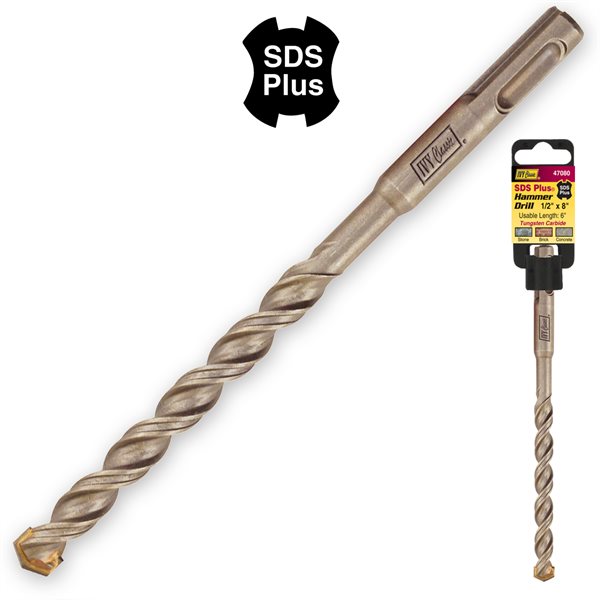
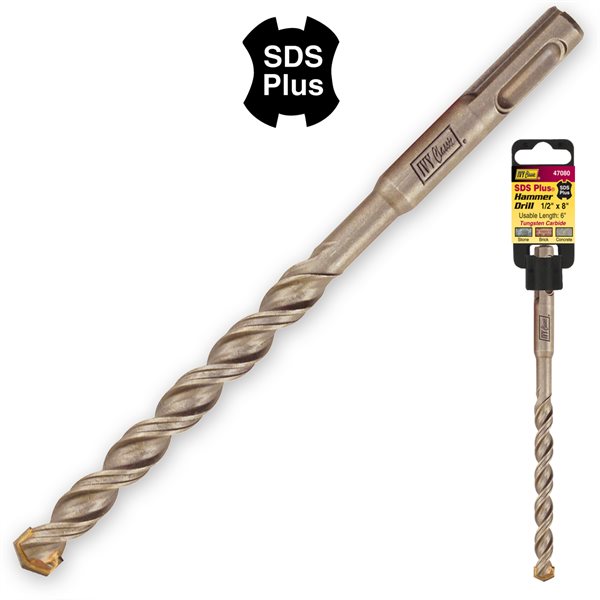
IVY Classic SDS Plus Hammer Drill Bit — Tungsten Carbide Tip, Masonry
SDS Plus Shank | Tungsten Carbide Tip | 22 Sizes | Concrete, Brick, Block, Stone | 4" to 12" Lengths | Fits All SDS Plus Rotary Hammers
The Rotary Hammer Bit Gutter Installers Reach for When the Fascia is Masonry
Not every gutter installation is a wood-frame house. Concrete block walls, poured concrete fascia boards, brick chimneys, and stucco-over-masonry soffits all require a rotary hammer with an SDS Plus bit to set the anchor holes that secure gutter hangers, downspout straps, and outlet fittings. A standard twist bit will not penetrate concrete or brick cleanly — it deflects, overheats, and fails. The IVY Classic SDS Plus hammer drill bit is built for exactly this application: a tungsten carbide tip brazed with copper-silver alloy for extreme heat resistance, a four-flute helical body that evacuates masonry dust as the bit advances, and the SDS Plus shank system that locks into any SDS Plus rotary hammer and delivers hammer energy directly to the tip without the bit spinning loose in the chuck. Available in 22 sizes from 3/16" to 3/4" diameter and lengths from 4" to 12", with usable lengths engineered for depth-matched anchor setting.
SDS Plus | Tungsten Carbide | 22 Sizes | Concrete, Brick, Block, Stone | Ships Nationwide from Damascus, OR
Key Benefits at a Glance
Copper-silver brazed tungsten carbide survives the repeated impact shock of hammer drilling in concrete, brick, and block — a tip that stays centered and sharp through anchor-depth drilling on demanding masonry substrates.
The two-slot, two-groove SDS Plus shank locks positively into any SDS Plus rotary hammer — hammer energy transfers directly to the carbide tip rather than being absorbed by chuck slippage that occurs with straight-shank bits in keyed chucks.
Deep helical flutes evacuate masonry dust and debris from the hole as the bit advances — cleared boreholes reduce heat buildup, prevent binding, and produce cleaner anchor holes with consistent diameter from entry to anchor depth.
Diameters from 3/16" to 3/4" and lengths from 4" to 12" cover every anchor size and drilling depth a gutter installation can require — one product line covers the full range from small strap anchors to large-diameter hanger lag pilot holes.
Why Gutter Installers Working on Masonry Structures Need an SDS Plus Bit, Not a Standard Drill Bit
Masonry anchor work on gutter installation jobs — also called concrete hammer drilling, rotary hammer drilling, SDS drilling, or masonry boring depending on the trade context — is a fundamentally different operation from drilling wood or metal. Concrete, brick, block, and stone cannot be cut with a rotating blade edge alone. These materials require repeated impact blows combined with rotation to fracture the substrate ahead of the bit and advance the hole. A standard corded drill or cordless driver applying rotational force alone against concrete will deflect off aggregate, generate enough heat at the tip to destroy a standard bit in seconds, and produce a shallow, off-center hole that cannot hold an anchor load. The SDS Plus hammer drill bit is the correct tool for this work — and the SDS Plus shank is the correct delivery system for it.
The SDS Plus system — developed by Bosch and now the universal professional standard for rotary hammer drill bits — uses a two-slot, two-groove shank that clips into the rotary hammer chuck with a spring-loaded locking mechanism. This allows the bit to slide freely in the axial direction under hammer blows while remaining rotationally locked to the chuck. The result is that every hammer impact from the drill's internal piston mechanism is transmitted directly to the tungsten carbide tip as axial energy — fracturing the masonry substrate ahead of the bit — while rotation advances the bit and the helical flutes carry debris out of the bore. No other shank system delivers hammer energy as efficiently as SDS Plus at the rotary hammer category, which is why every professional rotary hammer manufactured today uses an SDS Plus chuck.
GutterAll in Damascus, Oregon stocks the IVY Classic SDS Plus hammer drill bit line in the sizes most commonly needed for gutter installation and downspout anchor work on masonry structures — including the concrete block wall and brick chimney substrates common throughout the Portland metro area and Pacific Northwest residential construction. All orders ship nationwide. Local delivery and in-store pickup are available for contractors in the greater Damascus and Portland area.
| Spec | Detail | Gutter Application Relevance |
|---|---|---|
| Shank Type | SDS Plus (SDS+) | Fits all SDS Plus rotary hammers — the standard professional hammer drill on every masonry gutter job |
| Tip Material | Tungsten Carbide, Copper-Silver Brazed | Survives impact shock and heat buildup in concrete block, brick, and poured concrete anchor drilling |
| Flute Design | Four-Flute Helical | Continuous debris evacuation keeps anchor boreholes clear — anchors set to specified torque in clean, full-diameter holes |
| Diameters Available | 3/16" through 3/4" (22 sizes) | Covers all anchor sizes from small strap anchors (3/16", 1/4") to large hanger lag pilot holes (1/2", 5/8") |
| Lengths Available | 4", 6", 8", 12" (overall) | Usable lengths engineered per size | Featured 1/2" x 8" size has 6" usable length — appropriate for wedge anchor and sleeve anchor depth requirements in concrete block |
Stop losing time to bits that deflect off concrete. The right tool starts with the right shank.
Select the size for your anchor spec and add to cart — ships fast from Damascus, OR. Crew quantity orders: sales@gutterall.com
Why the Right Drill Bit Determines Whether a Masonry Gutter Job Goes Clean or Goes Wrong
Gutter installation on wood-frame construction is straightforward. Masonry substrate changes every variable. A concrete block wall requires a pilot hole drilled to the exact diameter of the sleeve anchor or wedge anchor being set — undersized and the anchor will not drive; oversized and the anchor cannot develop full holding force. A brick chimney gutter application requires drilling through the face wythe to a controlled depth without cracking the brick face — this requires a sharp, centered carbide tip and a hammer drill delivering controlled impact energy, not a deflecting consumer bit that wanders off the mortar joint into the brick face and causes the surrounding brick to spall. A stucco-over-masonry fascia requires drilling through the stucco surface coat and into the substrate without blowing out the stucco face at the entry point. All of these outcomes depend on the bit maintaining center, evacuating debris continuously, and delivering the tip energy to the substrate face rather than dissipating it in a loose chuck interface. The IVY Classic SDS Plus hammer drill bit addresses every one of these requirements by design — the SDS Plus shank eliminates chuck slip, the four-flute helical body keeps the bore clear, and the copper-silver brazed tungsten carbide tip maintains center and sharpness through the drilling depths that masonry gutter anchor work requires.
Gutter Installer and Cleaner Applications — Masonry Substrates
The IVY Classic SDS Plus hammer drill bit addresses five masonry drilling scenarios that arise directly on gutter installation and downspout work where bit selection determines anchor quality and rework risk:
| Gutter Application | The Drilling Challenge | Why It Helps |
|---|---|---|
| Concrete Block Wall Hanger and Strap Anchor Holes | Drilling sleeve anchor and wedge anchor pilot holes in CMU (concrete masonry unit) block walls for downspout strap anchors and outlet fittings — block aggregate deflects standard bits and collapses undersized holes | SDS Plus hammer action fractures block aggregate cleanly; four-flute body evacuates block dust continuously — pilot holes are full-diameter and clean from entry to anchor depth, so anchors set to specification on the first drive |
| Brick Chimney Gutter and Flashing Anchor Drilling | Drilling face-mounted J-hook and spike anchors into brick chimney stacks and brick-veneer gable walls for chimney cricket gutters and saddle flashing — deflection into mortar joints causes brick face spalling and off-center holes that will not hold anchor load | The sharp centered tungsten carbide tip penetrates the brick face with minimal lateral deflection — bit stays on the marked hole center through the hard face wythe and into the softer mortar joint behind it without causing face spalling |
| Poured Concrete Fascia and Ledger Anchor Drilling | Drilling large-diameter lag bolt pilot holes in poured concrete ledger boards and concrete fascia walls for heavy-duty gutter hanger systems on commercial and industrial structures — poured concrete with embedded aggregate is the most demanding masonry substrate for drill bits | Copper-silver brazed carbide tip maintains its braze joint integrity through the high impact loads and heat generated drilling aggregate-embedded poured concrete — tip stays bonded and centered through the full depth of large-diameter pilot holes |
| Stucco-Over-Masonry Downspout Bracket Penetrations | Drilling through exterior stucco coatings into the masonry substrate behind them for downspout strap brackets and expansion anchor bolts — the hard stucco surface coat over softer substrate creates a blow-out risk at the entry point that damages the stucco face finish | Starting the hole at reduced hammer mode (rotation-only or low-impact) through the stucco surface coat before engaging full hammer mode into the masonry substrate behind it keeps the entry point clean — sharp carbide tip does not walk across the stucco face before engaging |
| Stone and Natural Masonry Anchor Drilling on Historic Structures | Drilling anchor points in natural stone sills, fieldstone foundations, and historic brick on older residential structures during gutter replacement — irregular stone hardness and unpredictable aggregate composition creates tip failure risk with inferior carbide quality | High-quality tungsten carbide with copper-silver braze alloy maintains tip integrity through variable-hardness stone substrates — the braze bond does not fail under the thermal cycling that occurs when transitioning between soft mortar and hard stone aggregate in the same bore |
The SDS Plus Shank System — Why It Is the Professional Standard for Masonry Drilling
SDS Plus (Steckverbindung mit Drehsicherung Plus, or Slotted Drive System Plus) is the international professional standard for rotary hammer drill bits developed by Bosch in the 1990s and now adopted by every major rotary hammer manufacturer including Hilti, Milwaukee, DeWalt, Makita, and Metabo. The system uses a shank with two open drive slots and two closed locking grooves. When inserted into an SDS Plus chuck, spring-loaded balls engage the locking grooves to retain the bit while the chuck jaws engage the drive slots to transmit rotation. The bit is free to slide axially within the chuck — this is the critical design feature. When the rotary hammer's internal piston fires, the axial force is transmitted through the chuck directly to the bit's sliding interface, driving the carbide tip into the masonry substrate as a pure impact blow independent of the rotational drive. This axial freedom means 100% of the hammer energy reaches the substrate rather than being absorbed by a clamped chuck interface. The result is faster penetration, longer bit life, and lower operator fatigue compared to standard SDS or keyed chuck masonry drilling.
Tungsten Carbide Tip — Why Braze Quality Determines How Long the Tip Stays in the Bit
Tungsten carbide (WC) is the correct material for masonry drilling tip construction because its hardness (approximately 9 on the Mohs scale) allows it to fracture concrete, brick, and stone aggregate rather than being worn away by it. However, tungsten carbide is brittle — it cannot be formed into the complex bit body geometry required for flute evacuation. Instead, the carbide tip is manufactured as a ground insert and brazed onto a hardened steel bit body at the tip end. The quality of this braze joint determines how long the tip remains bonded to the body under the repeated thermal cycling and impact loading of rotary hammer work. Copper-silver braze alloy (used in the IVY Classic construction) provides higher joint strength and better thermal resistance than standard copper or zinc-silver braze alloys used in lower-cost bits — the joint survives the temperature excursions that occur when drilling dense aggregate concrete without debonding and losing the tip mid-hole, which destroys both the bit and the anchor hole.
Four-Flute Helical Body — Dust Evacuation as a Drilling Performance Factor
The four deep helical flutes machined into the IVY Classic SDS Plus bit body serve a critical function that goes beyond simply giving the bit its characteristic shape. As the bit rotates and advances into the masonry substrate, pulverized concrete, brick, or stone dust accumulates in the bore behind the tip. If this material is not continuously evacuated, it packs into the hole, increases the friction load on the bit body, generates additional heat, reduces the effective hammer impact reaching the tip, and eventually causes the bit to bind or seize in the bore. The helical flute geometry acts as a continuous auger, carrying fractured masonry debris up from the tip and out of the bore with each rotation. Four flutes provide more evacuation cross-section than two-flute designs, which is particularly important when drilling anchor-depth holes (typically 2" to 4" deep) in concrete block or poured concrete where debris volume is highest.
Selecting the Right Diameter and Length for the Anchor Being Set
Every masonry anchor type specifies a required pilot hole diameter and minimum depth. The drill bit selected must match this specification exactly — an undersized hole will not accept the anchor body, and an oversized hole will not develop the bearing surface required for anchor load capacity. For gutter installation anchor work, the most common anchor types and their typical pilot hole requirements are: screw anchors (3/16" to 1/4" pilot, 1.5" to 2" depth), sleeve anchors (3/8" to 1/2" pilot, anchor length plus 0.5"), wedge anchors (3/8" to 5/8" pilot, anchor length plus 1"), and concrete screws / Tapcon-style anchors (3/16" to 5/16" pilot, depth per manufacturer). The IVY Classic SDS Plus line covers all of these diameters across the 22-size range. For depth control, the usable length of the bit must exceed the required anchor embedment depth — the featured 1/2" x 8" (6" usable length) is appropriate for standard commercial wedge anchor applications. Shorter 4" and 6" overall-length bits are well-suited for the shallow anchor depths typical of residential downspout strap and gutter spike work.
Choosing the Right Size — Diameter and Length for Gutter Anchor Applications
Small Diameter — 3/16" to 1/4"
Pilot holes for screw anchors, concrete screws (Tapcon-style), and small strap anchor bolts. Compact 4" length appropriate for residential strap anchor work at standard wall penetration depths. Most common for downspout strap and J-hook anchor work on CMU block.
Best for: Downspout strap anchors, J-hook bolts, small screw anchor residential work
Medium Diameter — 5/16" to 1/2"
Pilot holes for sleeve anchors and standard wedge anchors used on gutter hanger systems, outlet fitting bolts, and fascia-mounted bracket anchors. 6" and 8" overall lengths cover standard anchor embedment depths on concrete block and brick veneer wall assemblies.
Best for: Sleeve anchors, standard wedge anchors, fascia bracket bolts, outlet fitting anchors
Large Diameter — 5/8" to 3/4"
Pilot holes for large-diameter wedge anchors and through-bolt applications on commercial and industrial gutter systems. 12" extended length for deep anchor embedment in thick poured concrete ledgers and commercial CMU wall assemblies where standard-length bits cannot reach anchor depth.
Best for: Commercial heavy-duty wedge anchors, industrial fascia through-bolts, deep embedment on thick concrete
Select the diameter and length matched to the anchor spec on the job — all 22 sizes ship from Damascus, OR.
Add to cart now — or email sales@gutterall.com for crew multi-size bundle pricing.
Key Features and Gutter Installer Benefits
| Feature | Construction Detail | Gutter Installer Benefit |
|---|---|---|
| Shank System | SDS Plus (two-slot, two-groove) | Full hammer energy transfer to carbide tip — no energy loss to chuck slip that occurs with keyed chuck masonry bits; drops directly into every SDS Plus rotary hammer on the crew truck |
| Tip Material and Braze | Tungsten Carbide, Copper-Silver Brazed | Tip stays bonded through thermal cycling in dense aggregate concrete — no tip debonding mid-hole that destroys the pilot hole and requires redrilling before anchor setting can proceed |
| Flute Count and Design | Four-Flute Helical | Continuous masonry dust evacuation from bore prevents binding, heat buildup, and reduced hammer efficiency — anchor holes are clean and full-diameter from entry to anchor depth |
| Size Range | 3/16" to 3/4" diameter | 4" to 12" overall length | 22 sizes | Single product line covers every anchor diameter and embedment depth from residential strap screws to commercial heavy-duty wedge anchors — one brand stocked for all masonry anchor work |
| Masonry Compatibility | Concrete, Concrete Block (CMU), Brick, Stone, Marble, Mortar | Covers all masonry substrates encountered on gutter installation — poured concrete ledgers, CMU block walls, brick chimney stacks, stone sill courses, stucco-over-masonry fascia |
| Usable Length Engineering | Usable length specified per size (1/2" x 8" = 6" usable) | Usable length exceeds standard anchor embedment depths — anchor holes reach full depth without the drill chuck bottoming on the wall surface before the bit reaches anchor depth |
The IVY Classic SDS Plus hammer drill bit — also known in the trades as an SDS+ drill bit, rotary hammer bit, masonry hammer bit, concrete drill bit, or SDS masonry bit — is the professional-grade drilling tool for every gutter installation job that involves a masonry substrate. The SDS Plus shank system, tungsten carbide copper-silver brazed tip, four-flute helical body, and 22-size range make this the correct specification for gutter installers, downspout crews, masonry contractors, and roofing professionals who drill anchor pilot holes in concrete, concrete block, brick, stone, and stucco-over-masonry on a regular basis. GutterAll in Damascus, Oregon stocks the IVY Classic SDS Plus hammer drill bit line in the sizes most relevant to gutter anchor work and ships all orders nationwide. Contact sales@gutterall.com for crew multi-size bundle pricing or to add anchor drilling supplies to any gutter installation supply order. Monday through Friday 7am to 4pm, Saturday 8am to 2pm PST.
Why Gutter Crews Specify the IVY Classic SDS Plus Hammer Drill Bit:
- SDS Plus Shank: Two-slot, two-groove shank delivers full rotary hammer impact energy to the carbide tip — no energy loss from chuck slip that affects keyed-chuck masonry drilling
- Tungsten Carbide Tip: Hardness sufficient to fracture concrete, brick, and stone aggregate without being worn away — maintains cutting geometry through the drilling depths masonry anchor work requires
- Copper-Silver Braze: Higher-strength braze alloy keeps the carbide tip bonded to the steel body through thermal cycling in dense aggregate concrete — tip does not debond mid-hole
- Four-Flute Helical Body: Continuous debris evacuation from bore prevents binding and heat buildup — anchor holes are clean and full-diameter from entry to anchor depth
- 22 Sizes Available: 3/16" to 3/4" diameter and 4" to 12" overall length — covers every anchor specification from residential strap screws to commercial wedge anchors
- Concrete Block (CMU) Drilling: Fractures block aggregate cleanly and evacuates block dust — sleeve and wedge anchor pilot holes set to specification on the first drive
- Brick and Mortar Drilling: Sharp centered tip penetrates brick face without lateral deflection into mortar joints — J-hook and spike anchor holes stay on the marked center
- Poured Concrete Durability: Copper-silver brazed tip survives the highest-stress application in masonry drilling — aggregate-embedded poured concrete that destroys inferior carbide braze joints
- Stucco-Over-Masonry Compatibility: Works in rotation-only mode through the stucco surface coat before hammer mode engages into the substrate — entry points stay clean and unsplit
- Stone Substrate Handling: Carbide and braze quality sufficient for variable-hardness natural stone on historic residential structures where aggregate hardness is unpredictable
- Universal Rotary Hammer Fit: SDS Plus is the universal professional rotary hammer standard — fits Bosch, Hilti, Milwaukee, DeWalt, Makita, Metabo, and all other SDS Plus rotary hammers
- Usable Length Specification: Usable length per size exceeds standard anchor embedment requirements — drill chuck does not contact the wall face before the bit reaches anchor depth
- IVY Classic Product Ecosystem: Bit from the same professional product line as IVY Classic utility knives and cutting supplies — consistent quality across the full tool supply line
- Reduced Rework Risk: Clean, full-diameter, on-center anchor holes set correctly the first time — no re-drilling oversized holes that cannot develop anchor load capacity
- Crew Inventory Simplicity: 22-size range within a single product line means all masonry anchor drilling needs are covered by one brand and one supplier — fewer sourcing decisions on the job
Product Specifications
| Product Type | SDS Plus Hammer Drill Bit — Masonry, Concrete, Brick, Block, Stone |
| Brand | IVY Classic |
| Shank Type | SDS Plus (SDS+) — Two-Slot, Two-Groove Universal Professional Standard |
| Tip Material | Tungsten Carbide |
| Braze Alloy | Copper-Silver — For Superior Heat Resistance and Tip Bond Strength |
| Flute Design | Four-Flute Helical — Continuous Masonry Debris Evacuation |
| Diameter Range | 3/16" through 3/4" — 22 Sizes Available |
| Length Options (Overall) | 4" (Compact) | 6" (Standard) | 8" (Standard-Extended) | 12" (Extended) |
| Featured Size | 1/2" Diameter x 8" Overall | 6" Usable Length |
| Compatible Drill Systems | All SDS Plus Rotary Hammers (Bosch, Hilti, Milwaukee, DeWalt, Makita, Metabo, and all other SDS Plus rotary hammers) |
| Compatible Substrates | Poured Concrete, Concrete Block (CMU), Brick, Natural Stone, Marble, Mortar, Stucco-Over-Masonry |
| Primary Trade Applications | Gutter installation anchor drilling, downspout strap and bracket anchors, roofing, masonry, general construction |
| Construction Grade | Professional Heavy-Duty — Commercial and Trade Use |
| Expected Service Life | Masonry drill bits are consumable cutting tools. Expected service life varies by substrate hardness, drilling depth, and hammer drill power. High-quality tungsten carbide with copper-silver braze provides significantly longer tip retention and usable life than standard carbide bits with lower-quality braze alloys. |
| Fulfillment Options | Ships nationwide | Local delivery | In-store pickup — Damascus, OR |
Who Specifies the IVY Classic SDS Plus Hammer Drill Bit
Gutter Installers and Downspout Crews (Primary)
- Drilling sleeve anchor and wedge anchor pilot holes in CMU block walls for downspout strap anchors
- Setting J-hook and spike anchor holes in brick chimney stacks and brick-veneer gable walls
- Drilling large-diameter lag bolt pilot holes in poured concrete fascia and ledger boards
- Penetrating stucco-over-masonry exterior walls for downspout bracket bolts
- Drilling natural stone and historic brick anchor points during gutter replacement on older structures
- Setting outlet fitting anchor bolts through masonry walls in commercial gutter systems
Why it matters: Masonry anchor quality determines gutter system holding force under wind and water load. An undersized, off-center, or collapsed anchor hole means the hanger or strap cannot develop rated load capacity — which is a liability and a callback risk on every masonry gutter job.
Roofing, Masonry, and General Contractors (Secondary)
- Drilling anchor bolt pilot holes in concrete block walls for flashing and coping anchorage
- Setting through-bolt penetrations in poured concrete for roofing attachment hardware
- Drilling mortar joint anchor points for stone veneer mechanical ties
- Setting expansion anchor bolts in concrete slab edges for ledger attachment
- Drilling pilot holes for concrete screw fasteners in residential foundation work
- General masonry anchor drilling across residential and commercial construction
Why it matters: SDS Plus compatibility, tungsten carbide tip quality, and the 22-size range make this the correct specification for any trade where masonry anchor drilling is a daily production task and bit quality directly affects anchor hole quality and installation pace.
Setup and Application Guide — Drilling Masonry Anchor Holes for Gutter Installation
- Verify the anchor specification before selecting the bit: Check the anchor manufacturer's published pilot hole diameter and minimum embedment depth for the specific anchor being used — sleeve anchor, wedge anchor, concrete screw, or expansion anchor. Select the IVY Classic SDS Plus bit diameter that matches the specified pilot hole size exactly. Oversize or undersize holes cannot develop the rated anchor load capacity.
- Confirm the bit usable length exceeds the required embedment depth: The usable length of the selected bit must be greater than the anchor's required embedment depth plus the depth of any surface materials (stucco, mortar bed, tile) the bit must pass through before reaching the structural masonry substrate. The featured 1/2" x 8" bit has 6" usable length — appropriate for standard commercial wedge anchor work.
- Insert the SDS Plus bit correctly into the rotary hammer chuck: Retract the chuck collar, insert the SDS Plus shank until it clicks positively into the locked position, then release the collar. Confirm the bit is retained by pulling it gently — it should slide slightly axially (normal for SDS Plus) but should not pull free of the chuck. A bit that is not fully locked will walk out of the chuck under hammer load.
- Mark the hole center precisely before drilling: Use a center punch and hammer to establish a dimple at the marked anchor location — particularly important on brick and tile surfaces where the drill tip will walk without a physical starting point. On smooth poured concrete, a center punch mark provides the tip with a seating point that prevents initial deflection.
- Set the rotary hammer to rotation-only mode for stucco or tile surface penetration: If drilling through a hard surface coating (stucco, ceramic tile, porcelain) before reaching the masonry substrate, begin in rotation-only mode at reduced speed to establish the entry point cleanly without blowing out the surface coat. Switch to full hammer-and-rotation mode once the bit has penetrated through the surface coating into the masonry substrate behind it.
- Apply steady controlled pressure — let the hammer do the work: The rotary hammer delivers the drilling energy through the piston mechanism, not through operator downward force. Excessive operator pressure does not increase penetration rate but does increase bit tip stress and heat buildup. Apply enough pressure to keep the bit advancing steadily, and allow the SDS Plus hammer action to fracture the substrate ahead of the tip at its natural rate.
- Withdraw the bit periodically to clear debris on deep holes: On holes deeper than 2" to 3", withdraw the spinning bit from the bore every 30 to 60 seconds to allow accumulated dust to evacuate from the flutes. The four-flute design handles most debris continuously, but deep holes in poured concrete generate debris volume that can exceed continuous flute capacity and cause binding if the bit is not periodically cleared.
- Set a depth stop or mark the required embedment depth on the bit: Use the rotary hammer's depth stop rod (if equipped) or wrap masking tape around the bit at a point equal to the required anchor depth from the drill chuck face. Drilling to consistent depth ensures anchors set to full embedment specification without over-drilling, which reduces bearing surface and anchor load capacity.
- Blow or vacuum debris from the completed hole before setting the anchor: Masonry dust in the anchor hole reduces the bearing surface contact between the anchor and the substrate. Use a bulb blower, compressed air, or a hole vacuum to clear dust from the full depth of the pilot hole before inserting the anchor body. This step is specified by most anchor manufacturers as a required installation step for full load-capacity anchor performance.
- Inspect the bit tip after each drilling session and replace when tip wear is visible: A tungsten carbide tip that has lost its sharp cross-tip grind profile will cause the bit to skate across the masonry surface rather than engaging cleanly, increasing the operator effort required and reducing hole quality. Replace worn bits before they reach the point of tip rounding that causes skidding — a moderately worn bit replaced promptly costs less time than a skidding bit that damages the work surface or causes an off-center anchor hole.
Drill clean anchor holes in concrete, block, and brick on every masonry gutter job.
Select the diameter and length for the anchor spec — add to cart and ship fast from Damascus, OR.
Crew multi-size bundles: sales@gutterall.com | Mon-Fri 7am-4pm, Sat 8am-2pm PST
Frequently Asked Questions
Q: Can these bits drill through poured concrete with embedded aggregate, or are they only suitable for concrete block and brick?
Yes, the IVY Classic SDS Plus hammer drill bit is designed for poured concrete with embedded aggregate as well as concrete block, brick, and stone. The copper-silver brazed tungsten carbide tip is specifically constructed to withstand the higher impact stress and thermal load generated when drilling through aggregate-embedded poured concrete — the harder the substrate, the more important the braze alloy quality becomes in preventing tip debonding. For large-diameter pilot holes in dense poured concrete, the 8" or 12" length variants provide the usable drilling depth required for commercial wedge anchor embedment specifications.
Q: What is the difference between an SDS Plus bit and a standard masonry bit, and why does it matter for gutter anchor work?
A standard masonry bit has a straight cylindrical or reduced-diameter shank that is held by friction in a keyed or keyless chuck. When the rotary hammer fires its piston, the impact energy must travel from the hammer mechanism through the chuck body and then into the bit through the clamped shank interface — a significant portion of the impact energy is absorbed by the chuck interface rather than reaching the carbide tip. The SDS Plus bit's two-slot, two-groove shank engages directly with the hammer mechanism's ball-lock system, allowing the bit to slide axially in response to each hammer blow. This means 100% of the piston impact energy is delivered directly to the carbide tip as forward thrust, rather than being absorbed by chuck friction. For gutter anchor work on concrete and block, this energy efficiency difference translates to faster drilling, lower operator fatigue on overhead and ladder work, and better anchor hole quality.
Q: Which size should a gutter installer carry for standard residential downspout strap and hanger anchor work on concrete block walls?
For standard residential gutter installation on concrete block (CMU) structures, the most commonly needed sizes are 3/16" and 1/4" diameter for concrete screw and small screw anchor applications, and 3/8" diameter for standard sleeve anchor applications. The 4" and 6" overall length variants are appropriate for the 1.5" to 2.5" embedment depths typical of residential strap anchor and J-hook anchor work. For heavier commercial applications using wedge anchors, 1/2" diameter with 8" overall length (6" usable) is the standard specification for 3/4" wedge anchor pilot holes at commercial embedment depths. Contact sales@gutterall.com with the specific anchor being used to confirm the correct bit diameter and length before ordering.
Q: What is the return policy?
IVY Classic SDS Plus hammer drill bits may be returned within 30 days of purchase in original, unused condition for a full refund or exchange. Bits that show signs of use